
The 5 execution gaps that undermine results – and the disciplined moves that close them
The Pattern
Most transformations don’t fail in strategy. They stall in execution. In the early stages of implementation, accountability begins to blur, communication fragments, and operational realities overwhelm good intentions. Progress slows, momentum fades, and transformation stalls. If left unaddressed, priorities shift, attention moves to the next initiative, and organizations never fully realize the value of the last…
Closing the gaps requires less new strategy and more disciplined execution
The Gaps
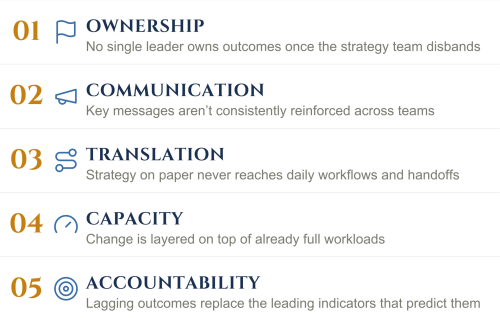
Across large-scale transformations, we find five execution gaps often emerge shortly after implementation begins, if not properly planned for:
01Ownership
Once the strategy team disbands, no single leader truly owns outcomes. Accountability diffuses across committees, dyads, functions, or leaders.
The Risk
- Decisions stall, issues linger, and frontline teams revert to old behaviors because no one is clearly accountable for results
Considerations
- Assign a single accountable operational owner with decision rights during implementation
- Establish clear escalation paths and a governance cadence that lasts beyond initial implementation timelines
02Communication
Leaders assume the message landed because it was announced. In reality, teams receive inconsistent or incomplete narratives that fail to drive aligned action.
The Risk
- Misalignment fuels resistance, workarounds, and confusion – especially across clinical and operational boundaries
Considerations
- Develop a repeatable leadership narrative and cascade it through multiple channels
- Focus less on what changed and more on what it means for each stakeholder group
03Translation
The future state makes sense on paper, but it never translates into daily workflows, decisions, or handoffs.
The Risk
- Teams comply superficially without changing day-to-day behaviors
Considerations
- Translate strategy into clear role-level expectations, workflow changes, and decision rights
- Pressure test with the frontline – if staff can’t describe what changed in their work, the transformation hasn’t truly started
04Capacity
Implementation is layered on top of already full workloads with little acknowledgment of real capacity constraints.
The Risk
- Burnout accelerates, shortcuts emerge, and adoption becomes optional under pressure
Considerations
- Treat capacity as a design input, not an afterthought
- Plan for capacity – sequence initiatives, temporarily rebalance workloads, or provide targeted backfill during critical implementation periods
05Accountability
Once live, performance is monitored through lagging outcomes rather than leading indicators.
The Risk
- By the time lagging metrics show underperformance, the behaviors behind it are already established and harder to change
Considerations
- Identify and track early adoption indicators and KPIs [usage, compliance, cycle time, decision turnaround]
- Embed KPIs through existing operating rhythms [staff meetings, executive committees, performance reviews]
Preparing for a Transformation?
Whether you’re about to embark on a major transformation or struggling to translate strategy into execution, we partner with your team to close these gaps before momentum fades. Let’s talk.